|
 |
||||
This
module compiled with information courtesy of the official NOAA Storm
Spotters Guide. |
||||
| SECTION FIVE: | ||||
 As in the other sections,
you can click on the glossary image wherever you see it, and the
glossary will open in another window. Just close that window when
you are ready to continue.
As in the other sections,
you can click on the glossary image wherever you see it, and the
glossary will open in another window. Just close that window when
you are ready to continue. |
||||
| NIGHT SPOTTING: | ||||
 |
||||
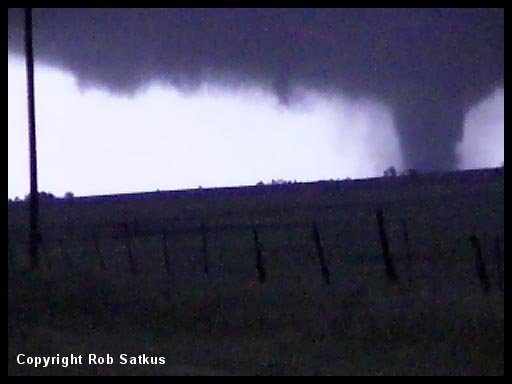
Perhaps one of the most dangerous aspects of spotting storms is that sometimes it is necessary to be done after dark. Unlike storm chasers who can kick off their shoes and stop when the sun sets if they so choose, the storm spotter is usually out there keeping an eye on the weather for his local community. Darkness brings a whole new aspect of trying to visually detect severe weather without getting caught up in it. However, there are a few visual clues you can look for in the flashes of lightning. The lightning is both good and evil when it comes to night spotting. Aside from the obvious danger of being struck, too little of it might not yield enough timely light for you to see what your looking for. Too much of it can have a strobe affect and seriously hinder your night vision. Depth perception is very difficult near thunderstorms at night, and makes judging distances very difficult. Add that to the fact that nearly every piece of scud cloud can look like a funnel cloud in the dark. Knowing your position in relation to the storm is absolutely critical for your safety and to have a good idea of what direction in the storm you might want to be looking. |
||||
VISUAL CLUES: STORM STRUCTURE: |
||||
|
||||
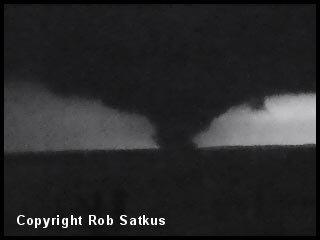
If
you are fortunate enough to have an adequate enough amount of lightning,
you will be able to see obvious things like this wedge tornado above
in Oklahoma during the May 3rd, 1999 tornado outbreak. If you see
something like this in the dark you are going to give yourself plenty
of safe distance. Large tornadoes like this may possibly have satellite
vortices that you might not be able to see before it's too late,
as well as the fact they can fling debris a pretty fair distance. |
||||
|
||||
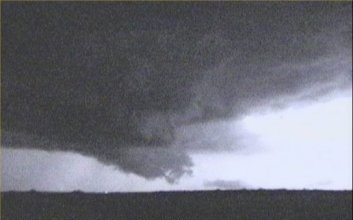
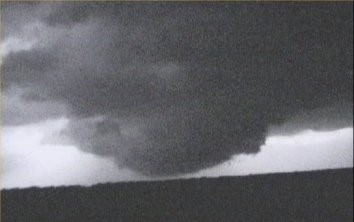
| Developing
wall cloud and later a very rounded wall cloud near Childress, TX
2001. As you can tell, key features can be determined, but to see
rotation you may have to look for other clues, such as striations
in the lower part of the storm. Most often the storm will not provide
enough lightning for you to detect positively wall cloud rotation,
however by looking at the evolution of the wall cloud in the above
images, and the well rounded "pregnant" appearance that
it took on, you can infer that it was most likely rotating. Don't
guess on your reporting too much after dark. If you aren't sure
what you are seeing, just tell them exactly what it is you think
you are seeing and why you think that. |
||||
 |
||||
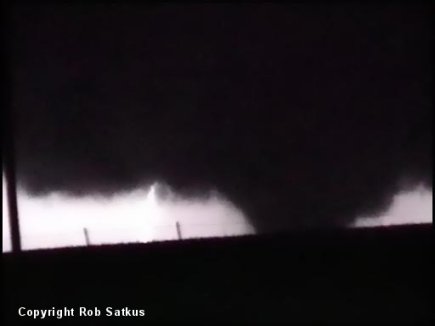
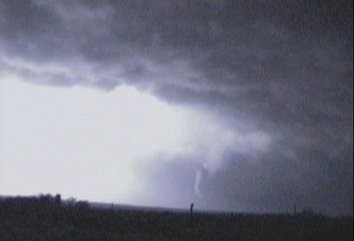
| In
the above image taken near Childress, TX in 2001 you can just make
out the small stovepipe funnel. The keys to identifying this one
in the dark was a fair amount of lightning. The feature persisted
for several minutes and may well have touched down, but we can't
determine that for sure. Something else that should key you in that
you are viewing the right area of the storm here is the RFD clear
slot coming around the funnel. This is exactly where we would expect
to see a tornado form. Combine this with it's persistence and we
can be completely sure this is exactly what it looks like. This
is where a thorough knowledge of your storm structure elements and
where they would be located in a storm can be extremely useful! |
||||
| POWER FLASHES: | ||||
|
||||
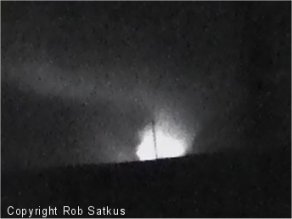
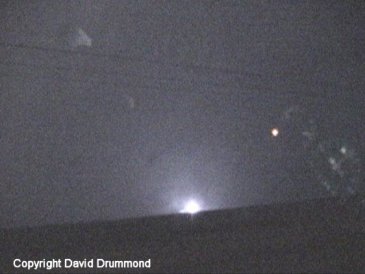
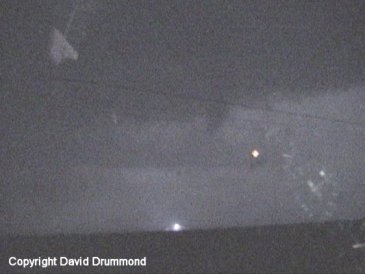
| Once
you have seen a power flash at night you know they are unmistakable.
They can vary in color, and are most often green or blue. These
are caused from power lines breaking, coming in contact with one
another or the ground, and sometimes by lightning striking a transformer.
They may not always be caused by a tornado, but if you are seeing
multiple power flashes, especially in a populated area, it is a
good chance that you have a tornado on the ground. These power flashes
were witnessed in a rural area and were quite brilliant. |
||||
 |
||||
|
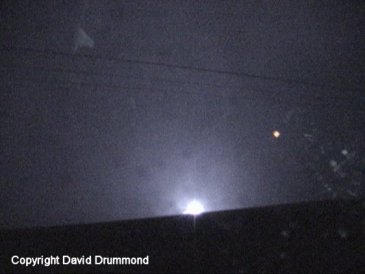
As
we see during yet another power flash and a timely lightning flash
we in fact have a tornado. Note that the funnel is not visible all
the way to the ground, but the power flash tells us that it is indeed
making contact. The NWS is interested in knowing if you see power
flashes under a potentially tornadic storm, particularly if there
are multiple ones in close succession. Numerous
power flashes are a sure sign that some sort of violent wind is
causing damage on the ground. |
||||
| I
plan to add more to this topic of night spotting as more material
is available. The important thing is to keep yourself safe out there.
Stay out of the precipitation at night if you are spotting mobile
as it will effectively blind you from seeing anything. Pay VERY
close attention to what is going on around you and keep your attention
on what you are out there for. It is recommended that you do not
try to spot storms at night alone. It's also recommended that you
don't do night spotting until you have plenty of daytime spotting
experience and feel comfortable being around a storm and identifying
all it's visual clues. |
||||
| |
||||


 |
||||